 How-to
How to Plan a Luxury Wedding: 2026 Step-by-Step Guide
Table of Contents
- Start With a Luxury Wedding Vision and Concept
- Build Your Luxury Wedding Budget Before Anything Else
- Choose a Venue That Carries the Design
- Create a Luxury Wedding Planning Checklist
- Set a Luxury Wedding Timeline With Decision Deadlines
- Select Vendors and Protect Yourself With Contracts
- Design the Guest Experience, Including Accessibility and Dietary Needs
- Luxury Wedding Ideas That Hold Up on the Day
- Frequently Asked Questions
Last Updated: October 18, 2026
Start With a Luxury Wedding Vision and Concept
A luxury wedding is a celebration where every choice, from the flowers to the farewell, is intentional, personal, and built around a clear design idea rather than a template.
Most guides jump straight to venues and vendors, but a venue only works if you know what you're putting inside it.
So start with three questions:
- What three words should guests feel when they walk in?
- Which moments matter most to you as a couple?
- What do you want people talking about a year later?
Write your answers down. Those answers become the filter for every budget line, contract, and design decision ahead.
Build Your Luxury Wedding Budget Before Anything Else
Your luxury wedding budget should be set before you book anything, because vendor quotes only make sense against a fixed total. Start with your total number, then allocate by category and track actuals weekly. The biggest mistake is budgeting by feel: couples book a venue they love, then discover the florals they wanted no longer fit.
Derive the total before you allocate it
Work from three inputs:
- Who is paying, and how much is committed. Confirm the actual dollar figure available, not a range, and whether it is a gift, a loan, or a shared contribution with strings attached.
- Guest count. Catering, rentals, stationery, transportation, and favors all scale per guest. A 40-guest dinner and a 250-guest reception at the same venue can differ significantly.
- Your top three priorities. Decide which two or three categories are allowed to run over, and which will absorb cuts. Write this down before any quote arrives.
A realistic allocation framework
Exact percentages vary by market and guest count, but a workable starting split can be considered:
| Category | Typical share of total | What it covers |
|---|---|---|
| Venue and catering | 40-50% | Site fee, food and beverage minimum, service charge, staff meals, cake |
| Design and décor | 12-18% | Florals, rentals, lighting, drape, stationery, signage |
| Entertainment and production | 8-12% | Band, DJ, sound, stage, lighting design, specialty performers |
| Photography and video | 6-10% | Lead shooter, second shooter, film, editing, album |
| Planning and coordination | 8-12% | Full-service planner, design fees, production manager |
| Attire, beauty, and paper | 4-7% | Gowns, suits, alterations, hair and makeup, invitations |
| Transportation and guest hospitality | 3-6% | Shuttles, welcome events, hotel blocks, guest concierge |
| Contingency | 10-15% | Weather, upgrades, overtime, short shipments, last-minute additions |
Treat the table as a starting point. A destination celebration pushes transportation and hospitality higher; a design-forward ballroom wedding pushes décor higher and venue lower.
How the big categories actually work
- Venue and catering. Many venues quote a food-and-beverage minimum rather than a flat fee, plus a service charge and applicable sales tax. Ask whether the minimum includes tax and service, and whether rentals, cake, and late-night food count toward it. A venue that looks cheaper on the site fee can cost more once the minimum and service charge are added.
- Design and décor. Florals are usually the largest single line inside décor, and they scale with both guest count and installation complexity. Ask for a line-item breakdown separating flowers, labor, delivery, and strike.
- Entertainment. Band pricing often includes travel, lodging, meals, and backline rental. Confirm what is included before comparing two quotes.
Regional variation is real, plan for it
Major metropolitan areas and destination resort regions carry higher labor, permit, and vendor rates than secondary markets, and destination weddings add travel and lodging for the vendor team. Before you set the total, get itemized quotes from vendors in your actual market rather than relying on national averages.
Track it like a project
Keep a single budget spreadsheet with four columns: estimated, quoted, contracted, and paid, and update it weekly with your planner. The gap between quoted and contracted is where surprises hide. Ask every vendor for an itemized quote, not a lump sum, that habit prevents most budget surprises.
Choose a Venue That Carries the Design
The right luxury wedding venue does half your design work before a single flower arrives. High ceilings, chandeliers, lush gardens, and strong architecture give your concept room to breathe.
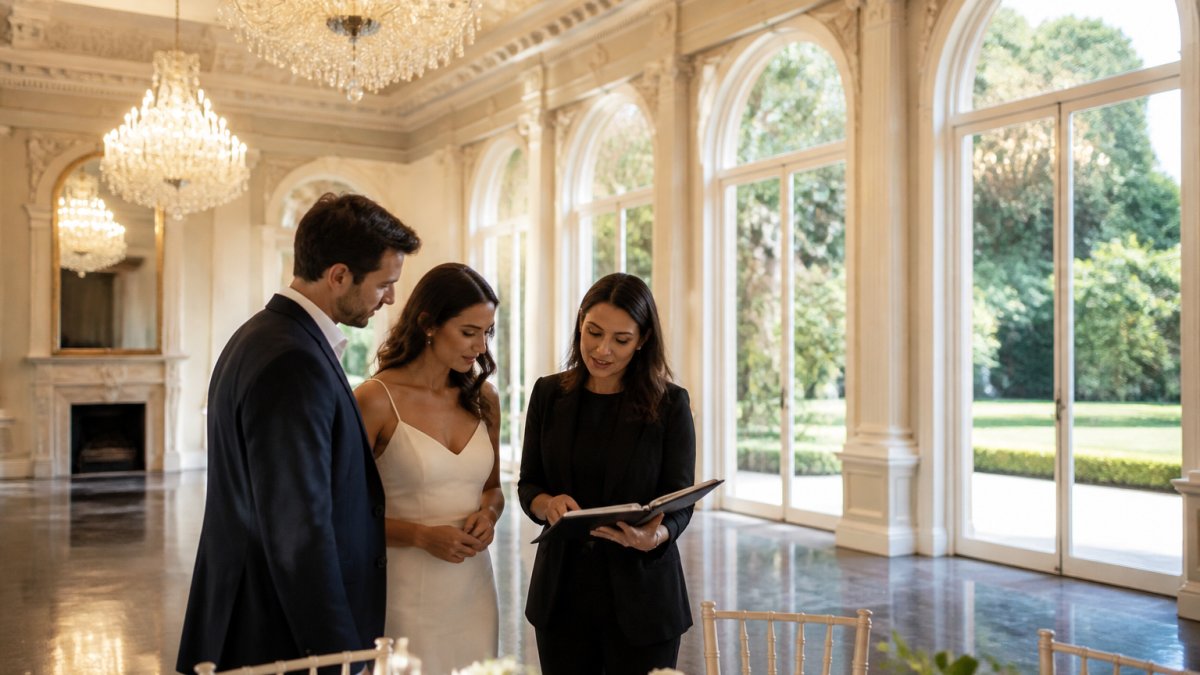
When you tour, check these in person:
- Ceiling height and natural light at your ceremony hour
- Power capacity for lighting and band production
- Rain backup that doesn't feel like a downgrade
- Load-in access and vendor curfews
Destination venues add travel logistics for every vendor and guest, so confirm local vendor availability and permit rules before signing.
Create a Luxury Wedding Planning Checklist
A luxury wedding planning checklist is a working document that tracks decisions, owners, and deadlines in one place. Keep it simple.
| Phase | What to Lock In | When |
|---|---|---|
| Foundation | Vision, budget, guest count, venue | 12-18 months out |
| Core vendors | Catering, photography, entertainment, florals | 9-12 months out |
| Design | Décor plan, rentals, stationery, lighting | 6-9 months out |
| Logistics | Timeline, seating, transportation, menus | 3-6 months out |
| Final month | Confirmations, payments, run-through | 30 days out |
Review it weekly with your planner. A checklist nobody opens is just decoration.
Set a Luxury Wedding Timeline With Decision Deadlines
A luxury wedding timeline works backward from your date, with a hard deadline attached to each decision. Without deadlines, decisions drift, and drift turns a calm engagement into a stressful final month. Here is how a timeline could be structured:
- 18 months out: set budget and guest count, book venue
- 12 months out: book catering, photography, and entertainment
- 9 months out: finalize design concept and floral plan
- 6 months out: order rentals, stationery, and attire
The last two weeks should be confirmation only. No new decisions.
Select Vendors and Protect Yourself With Contracts
Vendor selection comes down to portfolio fit, communication speed, and contract clarity. A stunning portfolio means little if replies take a week.
Compare proposals on the same page
Send every vendor in a category the same brief, date, venue, guest count, concept summary, and expected deliverables, then build a comparison sheet with these columns:
- All-in price, including travel, labor, delivery, strike, and applicable tax and service charge
- What is explicitly included, hours of coverage, number of staff, equipment, revisions
- What is explicitly excluded, and the vendor's rate for adding it
- Payment schedule, deposit, interim payments, final balance due date
A quote that is lower may exclude something a higher quote includes. The comparison sheet makes that visible before you sign.
Verify experience, not just portfolio
A portfolio shows the best frames from the best events. Ask for:
- Two recent events at your venue or a comparable one
- The name and role of the person who will lead on the day
- How the vendor handles a same-day equipment failure or illness on their team
- Whether they carry liability insurance and can provide a certificate naming your venue as additional insured, most venues require this
Call references and ask what went wrong, not just what went right. How a vendor describes a problem is more informative than a glowing review.
Read the contract for the clauses that matter
Most couples read the price and the date. The clauses that decide whether a problem becomes a crisis:
- Cancellation and postponement. What happens if you cancel, and what happens if the vendor cancels? Look for a refund of deposits, a rescheduling window, and a substitute-vendor provision.
- Force majeure. Confirm it covers weather, travel disruption, and public-health restrictions, and that it triggers rescheduling rather than forfeiture.
- Overtime. Confirm the hourly rate for extending coverage and who authorizes it on the day. A band or photographer running an extra hour should not be a surprise line item.
- Change orders. Any addition after signing should require a written change order with a price. Verbal upgrades are how budgets drift.
Coordinate the team as one unit
A high-end vendor team is a system, not a list. Your planner should run a single production schedule every vendor receives, with load-in times, sound checks, ceremony cues, and strike deadlines. Hold one joint walkthrough on site in the final weeks so every team sees the same room and plan.
Design the Guest Experience, Including Accessibility and Dietary Needs
Guest experience is where a luxury wedding earns its reputation, and it starts with inclusion. A beautiful room means nothing to a guest who can't navigate it or eat the meal.
Build these into planning early:
- Step-free routes to ceremony, reception, and restrooms
- Seating that works for older guests and wheelchair users
- A dietary intake question on the RSVP, with real menu options
- Quiet space for guests who need a break
Personalized details matter too: welcome notes, name cards, and transportation that runs on time. Small touches read as care.
Luxury Wedding Ideas That Hold Up on the Day
The best luxury wedding ideas still work when something goes sideways. A candlelit dinner is lovely until the power flickers; a garden ceremony is stunning until the forecast shifts.
Ideas worth the investment:
- Layered lighting so the room shifts mood from ceremony to dancing
- A statement entrance moment guests photograph all night
- Food stations plus plated service for variety without chaos
- Live music for cocktails, DJ for late night
Skip anything that only photographs well and feels hollow in person. Guests remember how the evening felt, not how it looked in a single frame.
Frequently Asked Questions
How far in advance should you plan a luxury wedding?
Most luxury weddings take 12 to 18 months to plan. Venues with high demand and top-tier vendors often book 12 or more months ahead, so securing the date early protects your first choices. If you are working with 8 months or less, move straight to budget, venue, and vendor contracts, and expect to pay for priority scheduling. A luxury wedding planner can compress the timeline, but some lead times for custom décor and floral design cannot be shortened.
What makes a wedding feel luxurious?
Luxury reads as ease, not excess. Guests notice service quality, comfortable pacing, and details that feel made for them: personalized menus, curated music, and a room that fits the guest count. High ceilings, chandeliers, and lush gardens help, but a selective guest list and a design that matches the couple's story matter more. A luxury wedding budget spent on guest experience and vendor coordination usually feels more elevated than one spent on more objects.
Can you have a nice wedding for $100,000?
Yes, a significant budget can produce a polished wedding in most markets if the guest list stays controlled. Costs vary widely by region, season, and vendor, so confirm quotes before committing and keep a contingency line.
What should you do first when planning a luxury wedding?
Set the total budget and the guest count before you tour a single venue. Those two numbers determine which venues, caterers, and vendors are realistic. Then write a one-page vision statement covering the mood, season, and three design priorities. With budget, guest count, and vision in hand, you can build a luxury wedding planning checklist and a luxury wedding timeline with real decision deadlines instead of guessing.
Planning a high-end celebration means juggling dozens of decisions, contracts, and moving parts at once. That's exactly where Centerpiece Productions helps. We build custom concepts around your vision, coordinate every vendor from load-in to last dance, and give you a team that handles the details so you can be present. Explore our decor and planning services, then get started with Centerpiece Productions and walk into your day knowing everything is handled.